Peptide purity testing commonly uses chromatography and mass spectrometry to answer different questions about an identified laboratory sample.
Peptide Purity Testing: What HPLC and Mass Spectrometry Show
A reported purity percentage can be useful, but it is not a complete description of a peptide sample. This guide explains what HPLC separates, what mass spectrometry measures and why analytical results should be read together with batch identity, net content and the full Certificate of Analysis.
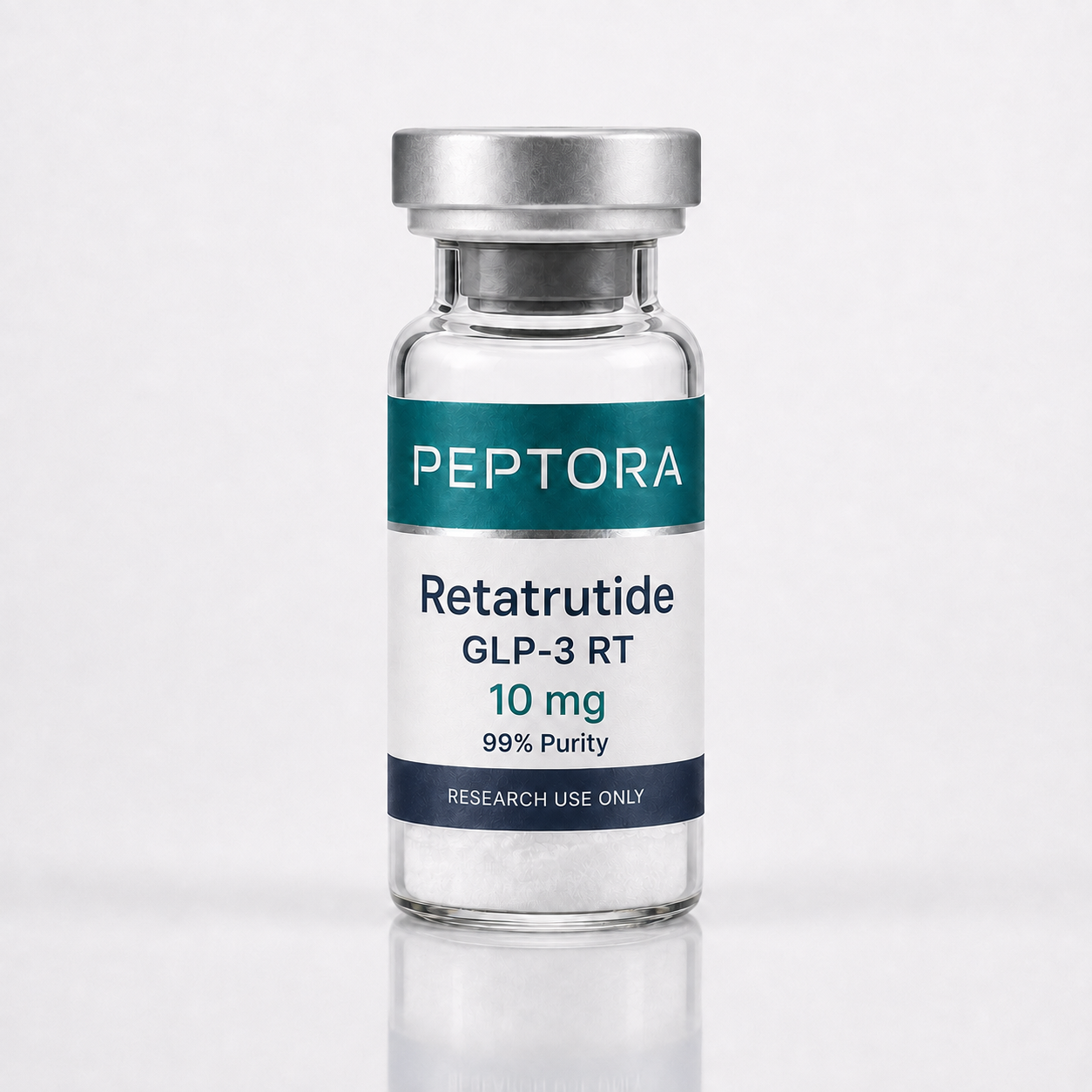 Illustrative chromatographic profile shown with a Peptora research vial
What Does Peptide Purity Testing Mean?
Peptide purity testing evaluates the relative amount of the principal detected component compared with other detected components under a specified analytical method. A chromatographic purity value is therefore tied to the sample preparation, separation conditions, detector and calculation used.
It should not be interpreted as a universal percentage of everything physically present in a vial. A purity result does not automatically state the peptide’s identity, the total milligrams supplied, sterility, endotoxin level, heavy-metal profile or absence of an untested contaminant.
How HPLC Is Used in Peptide Purity Testing
High-performance liquid chromatography separates sample components as they move through a column under defined conditions. A detector records a signal over time, producing a chromatogram with peaks.
Separation
Components interact differently with the stationary phase and mobile phase, causing them to elute at different retention times.
Detection
A detector—often UV for peptide analyses—records signals for compounds that respond at the selected wavelength.
Integration
Software integrates detected peaks. An area-percentage calculation may express the principal peak relative to total integrated peak area.
What Mass Spectrometry Adds to Peptide Purity Testing
Mass spectrometry measures mass-to-charge ratios of ionized molecules. For peptide analysis, the resulting spectrum can support assessment of molecular mass and identity, while coupled LC–MS workflows can connect chromatographic separation with mass information.
HPLC asks: what separates?
HPLC is valuable for resolving and estimating detected sample components under the selected method. Retention time alone, however, is not definitive molecular identification.
MS asks: what mass is detected?
Mass data can be compared with the expected molecular mass and can help investigate impurities. It does not, by itself, provide vial net content or sterility information.
Why HPLC and Mass Spectrometry Should Be Read Together
The methods provide complementary rather than interchangeable evidence. Regulatory and compendial sources describe using chromatographic and mass-spectrometric techniques together when analytical questions require both separation and characterization.
| Reported item | What it can support | What it does not establish alone |
|---|---|---|
| HPLC purity | Relative chromatographic peak-area profile under the stated method | Definitive identity, milligrams per vial or microbiological condition |
| Mass result | Observed molecular mass or mass-to-charge information | Chromatographic purity percentage or total vial content |
| Net content assay | Measured amount of the target material under the stated assay | Sterility, endotoxin result or full impurity characterization |
| Expanded screening | The specific sterility, endotoxin, heavy-metal or fentanyl-presence result reported | Any characteristic not included in that panel |
Limits of a Peptide Purity Percentage
A chromatographic percentage is meaningful only within the scope of its method and report. These are the most important limitations to remember.
Detector response differs
Different compounds may produce different detector responses. Peak area is not automatically equivalent to absolute mass composition.
Co-elution can occur
Two components may not be fully resolved. Orthogonal or higher-resolution methods can provide additional information.
Not everything is detected
A method detects what it is designed and capable of detecting under its stated conditions; an unperformed test has no result.
Peptide Purity Testing Is Only One Part of the Review
A high purity result is useful analytical information, but Peptora does not present it as the entire testing story. Where documented for the applicable batch, product pages provide access to broader third-party results and direct report verification.
Peptide Purity Testing FAQ
Does 99% HPLC purity mean that 99% of the vial is peptide?
Can HPLC confirm peptide identity?
Does mass spectrometry provide a purity percentage?
Why can two laboratories report slightly different purity values?
What should I verify before relying on a result?
Scientific and Regulatory Sources
- United States Pharmacopeia: Reference Standards to Support Quality of Synthetic Peptide Therapeutics
- U.S. FDA: Biotechnology Inspection Guide—HPLC description
- ICH Q6A via FDA: Specifications, Test Procedures and Acceptance Criteria
- ICH Q6B via FDA: Test Procedures and Acceptance Criteria for Biotechnological/Biological Products